Squarematch - Special Solutions
Symmetric Solutions
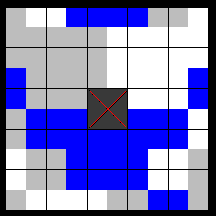
For the 5x5, the solution pictured here is the "most
symmetric".
With 3 colors and several asymmetric pieces which do not have mirror images,
perfect symmetry is not possible,
but there is a great deal of symmetry about the central vertical
column(s).
Blue is symmetric to itself,
and white and gray are symmetric to each other.
If you look at it as 10 rows (and columns) of colored squares,
the symmetry holds for the first nine rows, but it breaks down on
the 10th row.
In fact, only the last two pieces at the lower right corner break
the symmetry,
since there is not piece to pair with the checkerboard at the
lower left.
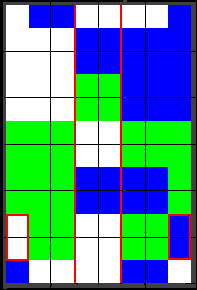
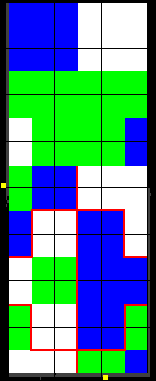 These figures show maximally-symmetric solutions for 4x6 and 3x8.
A few red lines have been added to emphasize the symmetry visually.
These figures show maximally-symmetric solutions for 4x6 and 3x8.
A few red lines have been added to emphasize the symmetry visually.
Here, blue and white are symmetric to each other (mostly) and green
with itself.
For the 4x6, only the 4 blue squares in the middle of
the right-hand green "P" are out of symmetry.
For the 3x8, there are
just 8 squares out of symmetry. They can be seen in green along a line
between the two yellow dots on the edge of the figure,
from the middle of the left hand side to just right of center
on the bottom.
Two-way solutions
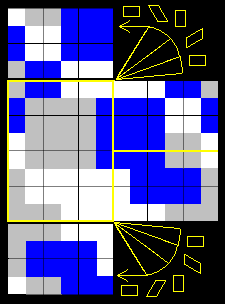
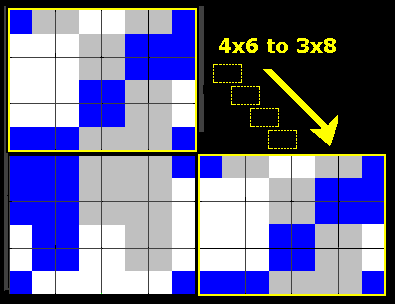
The 3x8 and 4x6 can also be solved "simultaneously" in 1527
different ways by finding two 3x4 rectangles which match up
along both a 3- and 4-edge, as shown in this figure. These
form 1493 different 3x8's and 1416 different 4x6's.
In this case, the left and right edges of the 3x8
solution match up, so the upper 4x3 block could be placed
on either the left or the right, yielding two 3x8s from
this 4x6.
Cylindricals
Furthermore, when two opposite edges match like that,
each column of 3 tiles can be moved from one end to the other,
yielding 8 different solutions. Such a solution might be called
cylindrical, since it could be wrapped around a cylinder, with
edgematching all the way around.
There are 1536 3x8 cylinders and
180 4x6 cylinders,
one of which is shown here.
This 4x6 cylinder can be "unfolded" (at either end)
to become a 3x8 cylinder!
Thanks to Jacques Haubrich for providing the idea to look at the
3x8, cylinders, and the transforms between 3x8 and 4x6.